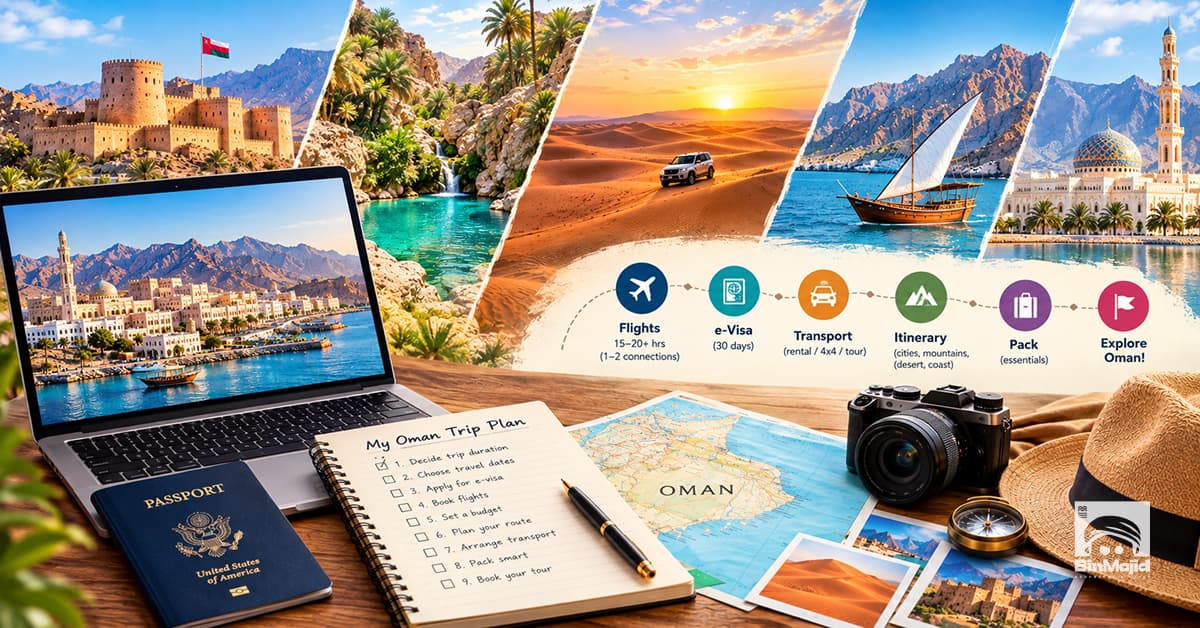

Planning or Looking for How to Plan a Trip to Oman from the US? Follow this step-by-step guide covering visas, flights, budget, itinerary, and booking your tour.
Oman isn’t a spontaneous, book-it-this-weekend kind of trip from the US — the flight time alone means it deserves a bit of planning. The good news: once you know the order to do things in, it’s a genuinely simple country to visit, and Bin Majid Tourism can handle the parts that usually trip up first-time visitors. Here’s exactly how to plan it, step by step.
Step 1: Decide How Long You Have
Because there are no direct flights from the US, a trip shorter than 7 days rarely feels worth the travel time. As a rule of thumb:
- 7 days — enough for Muscat, Nizwa, and one night in the desert
- 10 days — adds Wadi Shab, Jebel Shams, and more time on the coast
- 12–14 days — allows a trip south to Salalah (Dhofar) as well
Decide this first — it shapes every other decision below.
Step 2: Pick Your Travel Dates
Oman’s climate varies more than people expect. October through April is the most comfortable window for most of the country, with pleasant daytime temperatures for hiking, desert camping, and sightseeing. If you specifically want to see the southern Khareef season — when Salalah turns green and misty — aim for late June through early September instead, and plan your itinerary around the south rather than the north.
Step 3: Apply for Your Oman e-Visa
US citizens need an e-visa, applied for online before departure. Most travelers choose the 30-day single-entry tourist visa (roughly $52 USD), which comfortably covers a 1–2 week trip. You’ll need:
- A passport valid 6+ months beyond your travel dates
- Proof of onward/return travel
- A hotel booking or tour itinerary
- Travel insurance (often requested)
Approval is usually quick, so this can be done a few weeks out — no need to rush it months in advance.
Don’t want to deal with the paperwork yourself? Bin Majid Tourism can handle your Oman e-visa application as part of your booking — just send us your passport details and travel dates, and we’ll take care of the rest.
Step 4: Book Your Flights
Since there’s no non-stop route from the US, you’ll connect through a hub — commonly Doha, Istanbul, Dubai, Abu Dhabi, or Frankfurt, depending on your home airport. Total travel time usually runs 15–20+ hours door to door. Booking 2–3 months ahead generally gets the best fares, and it’s worth comparing a one-stop routing through the Gulf against a two-stop routing through Europe — sometimes the longer-looking option is actually cheaper.
Step 5: Set a Realistic Budget
A useful thing to know before budgeting: the Omani Rial (OMR) is pegged to the US Dollar at roughly 1 OMR = $2.60, and it’s one of the highest-valued currencies in the world — so prices that look small in rial can be deceptively higher in dollars. Build your budget around:
- Flights (often the single biggest cost from the US)
- Accommodation (ranges widely, from simple guesthouses to luxury desert camps)
- A private guide/driver, rental car, or organized tour (see Step 7)
- Activities like dune driving, wadi excursions, and entry fees
- Meals and incidentals
Pay by card where possible; ATMs are widely available in cities, but carry some cash for smaller towns and desert camps.
Step 6: Rough Out Your Route
A first-timer’s route usually flows in one direction rather than backtracking:
Muscat → Nizwa & Jebel Shams → Wahiba Sands desert camp → Wadi Bani Khalid / Wadi Shab → Sur → back to Muscat
If you have 12+ days, add a short domestic flight down to Salalah for the south.
Step 7: Decide: Self-Drive, Rental Car, or Guided Tour?
This is the decision that most shapes your trip. Oman is drivable, and a rental car gives you flexibility on the coastal and highway routes — but several of the best experiences, like dune driving in the Wahiba Sands and the steep mountain roads up Jebel Shams, really call for a 4×4 and local know-how rather than a standard rental sedan.
Whichever way you’d rather go, Bin Majid Tourism can set it up: book a rental car for a self-drive trip, arrange a 4×4 with driver for the desert and mountain sections, or put together a fully guided private tour so you don’t have to plan any of the logistics yourself. Get in touch and tell us what you need →
Step 8: Pack Smart
- Modest, breathable clothing — Oman is conservative; shoulders and knees covered is a safe default, especially at mosques and in rural areas
- A light jacket for cooler desert nights and mountain evenings
- Sturdy shoes for wadi walks and fort exploring
- Reusable water bottle — it gets hot, even in the cooler months
- A universal Type G plug adapter
Step 9: Book Your Tour or Itinerary
Once your dates, route, and travel style are settled, the last step is locking in your accommodation and, if you’re going the guided route, your local operator.
Ready to Turn This Plan Into a Trip?
Bin Majid Tourism handles the parts of an Oman trip that are easy to get wrong from abroad — the e-visa, a rental car or 4×4-with-driver, desert and mountain logistics, and full custom itineraries for US travelers.
Visit bmtoursoman.com to start planning →
Contact us for visa help, a rental car, or a full custom itinerary →